


On this page
The short version
- Collagen for cellulite has been studied in several clinical trials involving daily oral collagen peptide intake over multiple months — with measurable effects on skin structure and connective tissue.
- Collagen is not a miracle fix: effects only appeared after long-term, consistent intake — not after a few days.
- Cellulite is purely cosmetic and has nothing to do with cellulitis, the bacterial infection.
- Collagen creams mainly work on the surface; the effects studied here come from research on oral intake.
You're standing in front of the mirror, turn around, and there they are: the small dimples on your thighs or backside commonly known as cellulite. Collagen for cellulite has become one of the most-searched topics in supplements — for good reason, since collagen is exactly the structural protein responsible for the firmness of your connective tissue. As you get older, your body naturally produces less of it, which is often why that dimpled texture becomes more pronounced.
The reassuring part: cellulite is a purely cosmetic issue, not a health concern. The honest part: collagen is not a miracle cure that makes dimples disappear overnight. What the current research actually shows is more nuanced — and more interesting — than most online guides suggest. More on that shortly. In the meantime, our Collagen Intensive delivers a concentrated collagen peptide formula for your daily routine.
What is cellulite, exactly?
Cellulite — commonly nicknamed "orange peel skin" — describes the dimpled, uneven skin texture that mainly appears on the thighs, buttocks, and abdomen. It forms through the interplay of fat tissue pushing upward between vertically running strands of connective tissue, combined with connective tissue that gradually loses firmness with age or due to hormonal changes. Because women's connective tissue is naturally structured differently from men's, cellulite shows up far more often in women.
An important distinction: cellulite is not the same thing as cellulitis. Cellulitis is a bacterial infection of the tissue beneath the skin and a medical condition that needs to be treated by a doctor. Cellulite, by contrast, is harmless and purely cosmetic — even though it bothers many women in everyday life.
Why does cellulite often become more visible with age?
Your body naturally produces less of its own collagen as you get older. Connective tissue loses density and elasticity as a result, making it easier for fat cells underneath to push outward. Hormonal changes — particularly declining estrogen levels — additionally influence collagen production and fat distribution. Genetics also plays a role: some people naturally have looser connective tissue than others.
That explains why cellulite comes up so often for women between roughly 30 and 60 — and why many start paying closer attention to their collagen intake exactly during this life stage.
Want to see straight away which collagen product fits your routine best?
Explore Collagen IntensiveCollagen for cellulite: What the studies show
Most guides on this topic cite a single study that's now ten years old. We searched the current literature and also found a brand-new 2026 clinical trial that specifically examined thigh cellulite.
New study (2026): Collagen peptides and thigh cellulite
In a randomized, placebo-controlled trial, 114 women aged 20 to 50 with thigh cellulite and self-reported hair thinning received either 1,000 mg of low-molecular-weight collagen peptides or a placebo daily for 24 weeks. Measured outcomes included cellulite severity, the length of the dermal-subcutaneous border, skin roughness, and skin elasticity. The collagen group showed significant improvements across all of these measures at both 12 and 24 weeks compared with placebo — and hair diameter also increased measurably.
Source: Hwang et al., Journal of Medicinal Food, 2026
View the study on PubMed →Landmark study (2015): Collagen peptides and BMI-dependent effects on cellulite
In this double-blind, placebo-controlled trial, 105 women aged 24 to 50 with moderate cellulite took 2.5 g of specific collagen peptides or a placebo daily for 6 months. In normal-weight women, cellulite severity decreased significantly and skin waviness on the thighs was reduced compared with placebo. Dermal density also improved significantly. In overweight women, the effect was present but less pronounced than in normal-weight participants.
Source: Schunck, Zague, Oesser & Proksch, Journal of Medicinal Food, 2015
View the study on PubMed →Meta-analysis: Collagen and general skin elasticity
A systematic review covering 26 randomized controlled trials and 1,721 participants found that hydrolyzed collagen intake significantly improved skin hydration and elasticity compared with placebo. Since firmer, more elastic skin can also influence the visible texture of cellulite, this broader body of evidence adds further support to the more specific cellulite studies above.
Source: Pu et al., Nutrients, 2023
View the study →The evidence specifically on this topic is still fairly limited — there's considerably more research on collagen and general skin elasticity. What does show up consistently, though: regular, long-term intake of collagen can, according to the available data, improve the appearance of cellulite, without eliminating it entirely.
Our recommendation
For a long-term routine, we recommend concentrated, highly bioavailable collagen peptides — complemented by vitamin C, which, according to approved health claims, contributes to normal collagen formation for the normal function of skin.

Collagen Intensive
Our premium tripeptide formula with especially small, highly bioavailable collagen peptides — concentrated into convenient sachets for your daily routine.
Shop now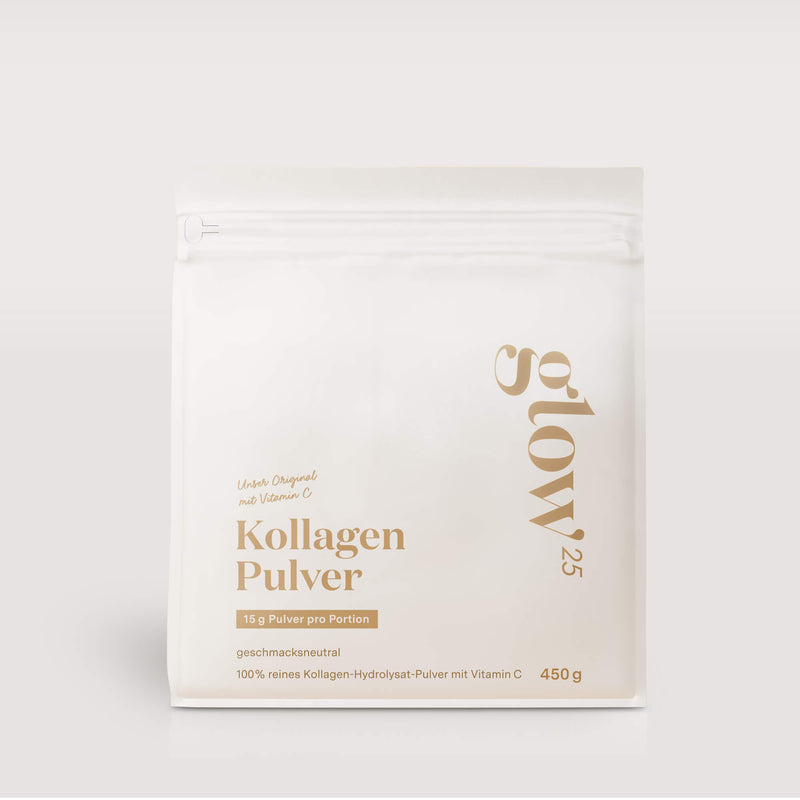
Collagen Powder: Germany's No. 1 with Vitamin C
Collagen hydrolysate with vitamin C for normal collagen formation — 100% pure, easily stirred into coffee, a smoothie, or water.
Shop now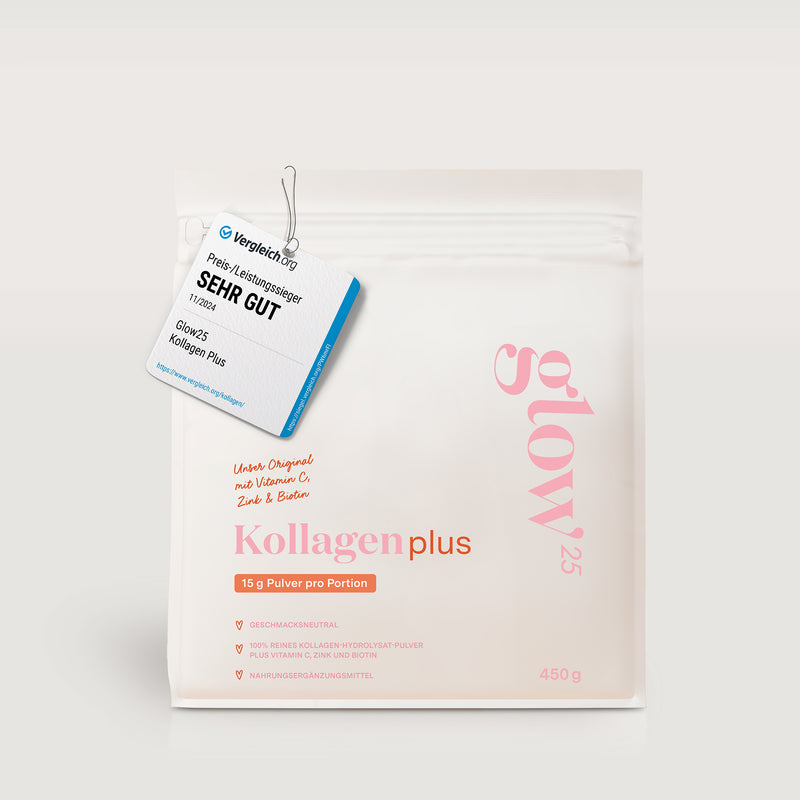
Collagen Plus
Collagen hydrolysate enriched with vitamin C, zinc, and biotin — for anyone who likes a few extra cofactors alongside the core effect.
Shop nowWhat customers specifically appreciate
Across more than 52,000 verified customer reviews, customers typically report noticeable changes to skin, hair, nails, or joint comfort after 8 to 12 weeks of daily intake. On the specific topic of skin texture and connective tissue, one pattern repeats itself: intake is described as an uncomplicated part of the morning routine, and changes are usually only noticed after several weeks of consistent use — not after a few days.
Why this matters day to day
Patience is especially important when it comes to cellulite. Anyone who gives up after two weeks because nothing has changed yet is quitting right around the point where, according to the research, the earliest effects would start becoming measurable. A routine that's easy to fold into everyday life — like stirring it into your morning coffee — makes the real difference between sticking with it and giving up.
Why Glow25 stands out here
Our collagen peptides are designed for high bioavailability, are flavor-neutral, and fit easily into existing habits. That "easy to stick with" factor is exactly what customers repeatedly describe as the deciding factor in their reviews.
Common reasons for satisfaction
- Simple, flavor-neutral daily intake
- A noticeable routine without elaborate rituals
- Combined with vitamin C as an additional cofactor
- Transparent sourcing and composition
Who might benefit from this?
Women in their mid-20s onward
When your body's own collagen production starts slowing down and you want to get ahead of it for your connective tissue.
During and after menopause
When declining estrogen levels noticeably affect skin firmness and connective tissue.
For a planned, long-term routine
For anyone willing to take a supplement consistently over several months — not as a quick fix.
Alongside an active lifestyle
As a complement to movement, adequate hydration, and a balanced diet — not a replacement for them.
For a broader set of goals
If you also care about hair, nails, or joint comfort alongside skin appearance, since collagen supports these more broadly.
How this fits into a routine
The positive effects of collagen on cellulite observed in studies only appeared after several months of daily, consistent intake — not after a single use. Rather than relying on one measure alone, it helps to take a broader view:
- Consistency over quantity: A daily routine you actually stick with for weeks matters more than a perfect single dose.
- Stay hydrated: Adequate fluid intake supports skin elasticity and nutrient absorption.
- Everyday movement: Regular activity supports circulation in connective tissue.
- Plan for patience: Give it a realistic several months before checking in on results.
For more on patience and timing, read our article When Does Collagen Start Working? Results After Weeks and Months.
Frequently asked questions
Does collagen really help with cellulite?
Early clinical studies suggest that regular, long-term intake of collagen peptides can improve the visible appearance of cellulite on the thighs, for example through a denser dermis and less visible skin unevenness. Collagen is not a miracle cure, but it may be one building block among several factors.
What's the actual difference between cellulite and cellulitis?
Cellulite describes the harmless, dimpled skin texture that results from the interplay between connective tissue and fat tissue. Cellulitis, on the other hand, is a bacterial infection of the tissue beneath the skin and a medical condition. Despite the similar name, the two have nothing to do with each other.
How long does it take to notice a difference?
In the studies available, collagen peptides were taken daily over several months before measurable changes in skin structure and connective tissue were observed. Short-term effects after just a few days are not realistic for this topic.
Which type of collagen makes sense for cellulite?
The cellulite studies used low-molecular-weight, highly bioavailable collagen peptides or collagen hydrolysate. More important than any single brand is regular, long-term intake as part of a balanced routine.
Can a collagen cream reduce cellulite?
Cellulite forms in deeper layers of skin. Creams mainly act on the surface and may improve how skin feels in the short term, but they barely reach the structures relevant to cellulite. The positive effects studied here come from research on oral intake, not topical application.
Does collagen replace exercise and diet for cellulite?
No. Collagen is a dietary supplement, not a replacement for a balanced diet, sufficient movement, and adequate fluid intake. It can complement these factors, but not replace them.
Conclusion
Collagen for cellulite isn't a marketing myth, but it's not a miracle cure either: the current research — including a brand-new 2026 clinical trial — shows that regular, long-term intake of collagen peptides can improve the visible appearance of cellulite. If you bring realistic expectations, stay consistent, and treat collagen as one part of a routine alongside movement, diet, and adequate hydration, you're in the best position to find out for yourself whether it makes a difference.


