


Marine collagen shows up in nearly every collagen comparison, usually with the promise that it's "better absorbed" than collagen from cattle. But what's actually behind that claim, where does fish collagen come from, and who does it genuinely suit?
This article looks at marine collagen without the marketing gloss: origin, the research, how it differs from bovine collagen, and honest answers to the questions you're probably asking.
What's in this article
What is marine collagen exactly?
Marine collagen is hydrolyzed collagen sourced from fish rather than cattle – usually from the skin. At Glow25, the fish collagen comes from tilapia raised in aquaculture certified to FOS (Friends of the Sea) and BAP (Best Aquaculture Practices) standards. The fish skins are broken down enzymatically (hydrolysis) into a fine, water-soluble collagen hydrolysate.
Marine collagen is mostly type 1 collagen – the same type that makes up most of human skin. That's why fish collagen is so often studied in relation to skin hydration and elasticity.
Marine collagen vs. bovine collagen: what's the difference?
The honest answer first: neither source is categorically "better." Both deliver high-quality, well-researched collagen hydrolysate – the difference lies in details that may matter for different needs.
| Marine collagen (fish) | Bovine collagen | |
|---|---|---|
| Collagen type | mostly type 1 | type 1 and type 3 |
| Molecule size | often smaller, depending on filtration | depends on degree of hydrolysis |
| Suitable for pescatarians | yes | no |
| Fish allergy | not suitable | suitable |
| Raw taste | can be slightly "fishy" without good filtration | neutral |
In Glow25 Collagen Intensive, the marine collagen is further broken down enzymatically into a particularly small peptide size of around 500 Dalton – markedly finer than classic collagen hydrolysate at 2,000–4,000 Dalton. That's why just 2.5 g per day is enough here, while powders with a larger molecular structure are typically dosed at 15 g.
Glow25 Collagen Intensive in detail
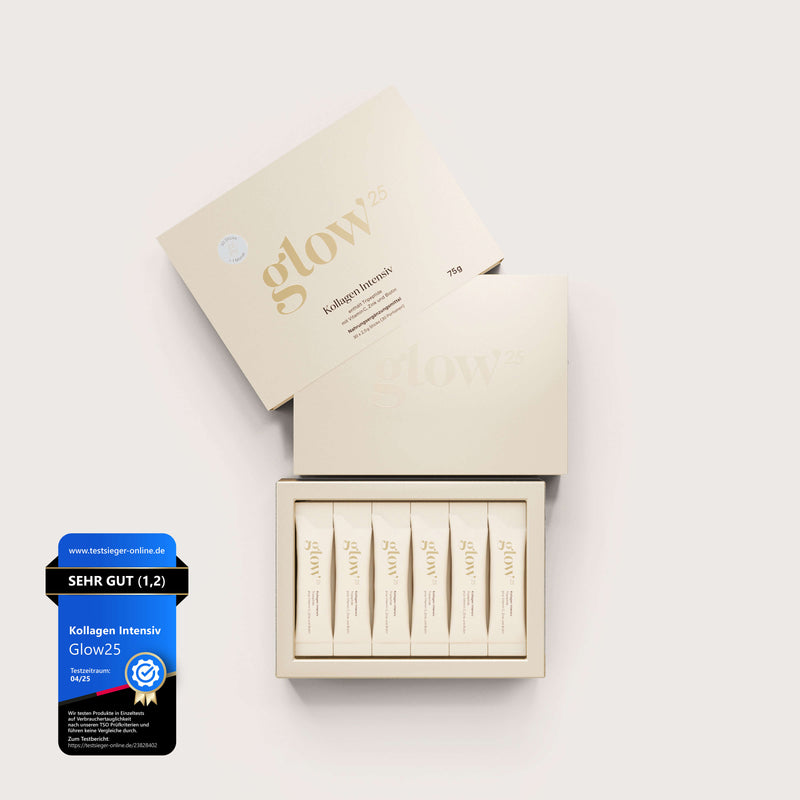
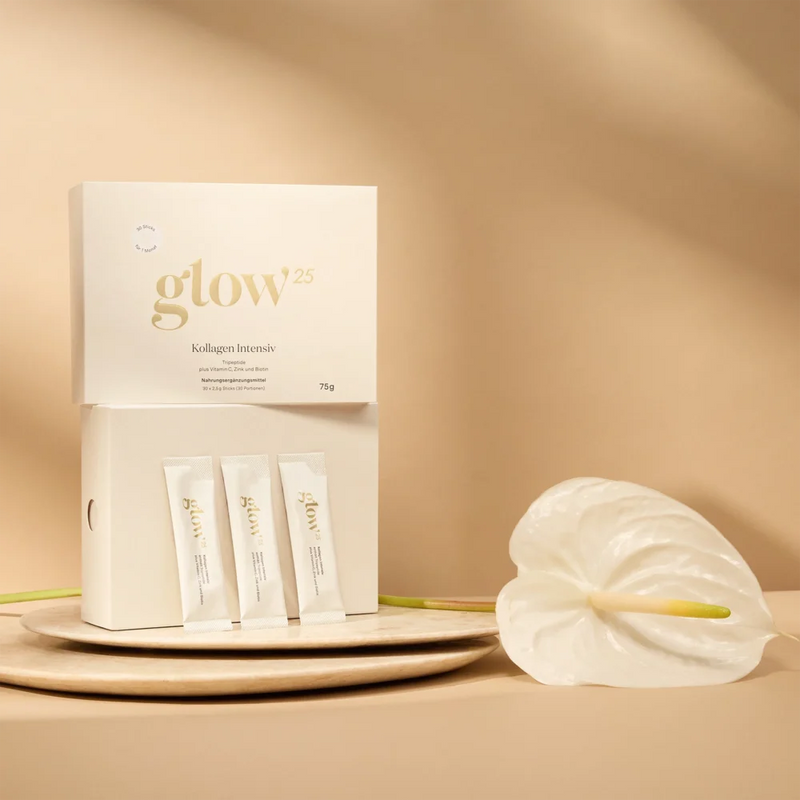
Marine collagen at tripeptide size
With its innovative tripeptide formula (around 500 Dalton), Glow25 Collagen Intensive delivers a particularly fine molecular structure from 98% fish collagen hydrolysate. The convenient sticks are perfect for on the go – just tear, stir, and enjoy. Each portion also includes vitamin C, zinc, and biotin.
Ideal for: pescatarians, frequent travelers, and anyone looking for a particularly finely broken-down collagen source.
From our Glow25 consumer test 2025 (40 participants, 8 weeks): 90% found the application pleasant, 86% would recommend it, 70% felt more supported from within.
Discover Collagen Intensive →What the research shows
The research specifically on oral, hydrolyzed marine collagen is younger than the bovine collagen literature, but it's growing. A recent review summarizes that hydrolyzed marine collagen is well distributed in the body after oral intake and shows positive effects on skin parameters in early controlled trials – though the authors note that research on ideal dosing and age groups is still in its early stages.[1]
A placebo-controlled 2026 study examined a low-molecular-weight collagen peptide likewise derived enzymatically from fish skin. Over 24 weeks, the treatment group showed significant improvements in skin elasticity, skin roughness, and cellulite severity compared to placebo, along with a measurable increase in hair shaft diameter.[2]
Broader meta-analyses of collagen peptides overall – regardless of source – support the same picture: an analysis of 26 randomized controlled trials involving over 1,700 participants found significant improvements in skin hydration and elasticity following oral collagen intake.[3] A placebo-controlled trial in an East Asian population found significant improvements after 12 weeks in skin luminosity, hydration, and nail brittleness.[4]
Early evidence also points to a link between collagen peptides and gut health: one study found that collagen peptides can influence gut microbiota composition, which in turn may benefit skin parameters.[5] This evidence is still preliminary.
An important note on framing: research findings are not a cure claim. Supplements like collagen powder don't replace a balanced diet and only work with regular, long-term use.
Who might benefit from marine collagen?
- Pescatarians who don't want bovine collagen but still eat fish
- Frequent travelers and busy professionals looking for a precisely pre-dosed, small portion
- Women from their mid-20s onward, when the body's own collagen production measurably declines
- Anyone already taking bovine collagen who wants to add a second, different source to their routine
- People with a sensitive stomach, who may benefit from a particularly small peptide size
Marine collagen isn't suitable if you have a known fish allergy – in that case, take a look at our Original collagen powder, which is bovine-based.
Fitting marine collagen into your routine
Collagen doesn't work overnight. For a realistic timeline, see our guide When does collagen start working? Results by week and month. Roughly: internal processes begin right away, visible skin changes often appear after 4–8 weeks, and hair, nails, and joints typically need 3 months or longer.
In practice, for marine collagen in stick form, that means stirring one stick into a glass of water, cold coffee, or a smoothie in the morning or at midday – done.
Frequently asked questions
What exactly is marine collagen?
Marine collagen is hydrolyzed collagen from fish skin – at Glow25, from certified tilapia farming. It's mostly type 1 collagen, the type that also shapes human skin.
Is marine collagen better than bovine collagen?
Not categorically better, just different: fish collagen tends to have a finer structure and suits pescatarians. Bovine collagen also provides type 3. What matters most for bioavailability is the degree of hydrolysis, not the source alone.
Does marine collagen taste like fish?
Not when it's well filtered. Glow25 Collagen Intensive uses a special process to stay flavor-neutral, dissolving into water or warm drinks without any aftertaste.
Who should avoid marine collagen?
If you have a known fish allergy, skip marine collagen and choose a bovine collagen variant instead. If you're pregnant, breastfeeding, or managing a pre-existing condition, check with a healthcare professional first.
How much marine collagen should I take daily?
It depends on the product. Glow25 Collagen Intensive is dosed at just 2.5 g per day thanks to its particularly fine tripeptide structure. Always follow the recommended intake on the packaging.
Can I combine marine collagen with other collagen products?
Yes, that's possible – ideally spaced apart, for example one product in the morning and the other in the afternoon. As a rule of thumb, stick to a maximum of two collagen products per day.
The takeaway
Marine collagen isn't a better or worse choice than bovine collagen – it's an equally well-researched alternative with its own advantages: a finer molecular structure, suitability for pescatarians, and in its tripeptide form, a particularly practical dose. If you value transparent sourcing, tested quality, and effortless daily use, Glow25 Collagen Intensive is a thoughtful way to put that into practice.
Keep reading
Ready for your glow?
Discover Glow25 Collagen Intensive and start risk-free – with a 60-day money-back guarantee.
Discover Collagen Intensive →Sources: [1] Bartoletti et al. (2025), Clin Cosmet Investig Dermatol, pubmed.ncbi.nlm.nih.gov/41393269 · [2] Hwang et al. (2026), J Med Food, journals.sagepub.com/doi/10.1177/1096620X261428336 · [3] Pu et al. (2023), Nutrients 15(9):2080, mdpi.com/2072-6643/15/9/2080 · [4] Vleminckx et al. (2024), J Cosmet Dermatol, onlinelibrary.wiley.com/doi/10.1111/jocd.16458 · [5] pubmed.ncbi.nlm.nih.gov/40497369


