-
Collagen x
-
de x
-
es x
-
Aug 17, 2026
How Hormones and Your Gut Both Decide Whether You Lose Your Hair
Hair loss in women gets explained online almost every time as a simple nutrient gap — "eat more iron, take biotin, done." That misses a lot. For many women, it's a combination of two things that rarely get discussed together: hormonal shifts, and whether your body can actually absorb the nutrients you're eating in the first place. Here's a science-based look at both sides — no overpromising.
Contents
Thinking about your gut microbiome?Glow25 Balance supports gut balance, which also plays a role in nutrient absorption.
Discover Balance →When it's not about your shampoo: the hormonal side of hair loss
Whether it's after pregnancy, after stopping the pill, or during menopause, many women suddenly notice more hair on the brush — and the first instinct is often to switch shampoos. In most cases, the real cause lies elsewhere: in hormone levels.
Estrogen keeps hair in its growth phase (anagen) for longer. When estrogen drops, that phase shortens, and more hairs shift into the resting phase at the same time before shedding. That's why hair loss in women clusters around three life stages: a few months after giving birth (estrogen falls sharply after pregnancy), after stopping hormonal contraception, and during perimenopause and menopause, when the ovaries gradually wind down estrogen production.
For some women, there's also a relative shift in hormone balance at play: when estrogen drops while androgen levels (including testosterone) stay the same or rise proportionally, that can make hair follicles at the crown more sensitive. Polycystic ovary syndrome (PCOS), in which the body produces more male sex hormones, is another common hormonal trigger.
Source: menopause and hair loss review, Maturitas (2025).
Worth knowing: hormone-related hair loss is usually diffuse — hair thins evenly across the scalp or more visibly at the part line, rather than forming isolated bald patches. If hair loss is sudden, patchy, or persists heavily over several months, it's always worth seeing a dermatologist or gynaecologist to rule out other causes such as thyroid conditions.
The overlooked factor: what your gut has to do with your hair
Here's what most "hair loss in women" guides leave out: the link between gut health and hair growth — often called the gut-hair axis. It's become its own area of dermatological research.
A review in the Journal of Clinical and Aesthetic Dermatology describes how an imbalance in gut bacteria (dysbiosis) is associated with several forms of hair loss. The authors explain this partly through the role gut bacteria play in absorbing certain nutrients relevant to the hair cycle, such as vitamin D and short-chain fatty acids. One controlled study cited in the same review is particularly interesting: in people with pattern hair loss, daily intake of a fermented kimchi-and-cheonggukjang product over four months led to a measurable increase in hair count and hair thickness compared with baseline.
Source: Carrington et al., "The Gut and Skin Microbiome in Alopecia: Associations and Interventions," Journal of Clinical and Aesthetic Dermatology, 2023. View study →
Another review, in Frontiers in Microbiology, goes a step further: certain gut bacteria actually compete with the body for nutrients. In one cited animal study, a disrupted gut microbiome combined with a biotin-poor diet led to hair loss — because certain bacterial strains claimed the available biotin for themselves before the body could use it. The authors also describe how a weakened gut barrier ("leaky gut") can be linked to systemic inflammation, which in turn can disrupt the hair cycle.
Source: Liu & Liu, "Gut microbiome, metabolome and alopecia areata," Frontiers in Microbiology, 2023. View study →
Why "eat more iron" doesn't always work
Iron, zinc, and vitamin D deficiency are among the best-documented nutritional causes of hair loss in women — several systematic reviews in recent years agree on this. What often gets missed: a deficiency doesn't only come from eating too little of something. It can also happen when absorption in the gut is impaired. Both scenarios end up looking the same on a blood test, but they call for different responses.
That's exactly the gap most guides leave open: if you have low ferritin or zinc levels despite an "adequate" diet, it's worth thinking beyond the menu and also about how well your gut is actually absorbing what's on it. A varied, balanced diet remains the foundation — but it's only half the equation if absorption in the gut is the real bottleneck.
Where Glow25 Balance fits in
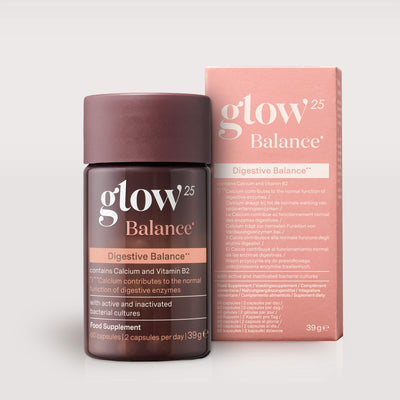
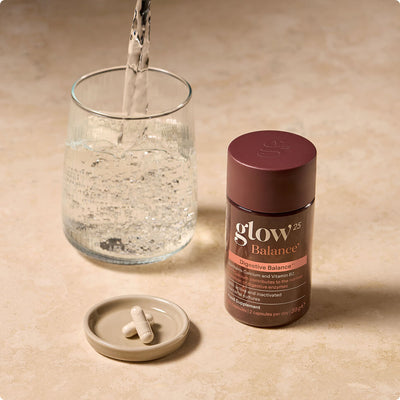
Glow25 Balance is not a hair-loss treatment, and it does not contain iron, zinc, or biotin — we want to be upfront about that rather than gloss over it. What the 3-in-1 tribiotic formula of active and inactivated lactic acid bacteria, inulin, and kiwi fruit powder does support is gut balance itself — the foundation nutrient absorption depends on in the first place. The formula is complemented with vitamin B2, which contributes to the maintenance of normal skin, and calcium, which supports the normal function of digestive enzymes.
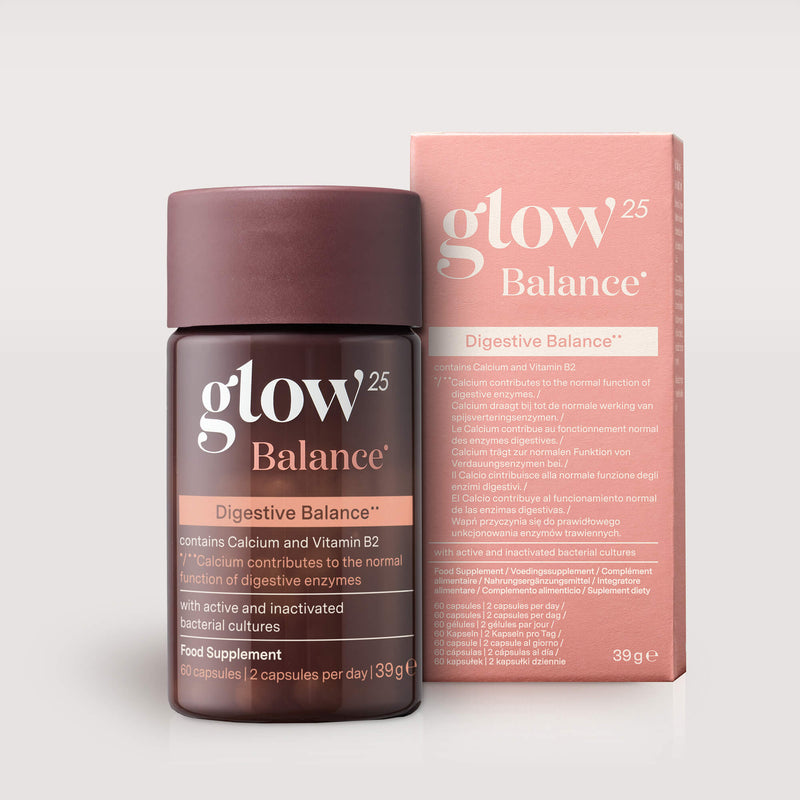
Glow25 Balance
Active & inactivated lactic acid bacteria, kiwi fruit powder, and inulin — for a gut microbiome in balance, as a foundation for nutrient absorption.
- 3-in-1 tribiotic formula: fiber + active & inactivated bacterial cultures
- With vitamin B2 (maintenance of normal skin) & calcium (normal function of digestive enzymes)
- Just 2 capsules a day, easy to combine with your existing routine
Myths vs. facts about hair loss in women
Frequently asked questions about hair loss in women
Which hormone is most often involved in hair loss in women?
Declining estrogen is the most common factor, typically after pregnancy or during menopause. Estrogen extends the hair growth phase; when it drops, that phase shortens and more hairs enter the resting phase at the same time. In some women, a relative rise in androgen hormones plays an additional role.
How can I tell if my hair loss is hormone-related?
Hormone-related hair loss usually shows up as diffuse thinning across the scalp or more visibly at the part line, rather than isolated bald patches. If it coincides with pregnancy, stopping the pill, or menopause, a hormonal link is likely. A reliable diagnosis, though, needs a medical exam and bloodwork.
What does the gut have to do with hair loss?
Research on the gut-hair axis shows that an imbalance in gut bacteria can be linked to several forms of hair loss — partly because certain gut bacteria are involved in absorbing nutrients like vitamin D that are relevant to the hair cycle. The research is promising but not yet conclusive.
Is hair loss during menopause normal?
Yes, hair loss is one of the more common but less-discussed symptoms of perimenopause and menopause, usually driven by declining estrogen, which shortens the hair follicle's growth phase. That doesn't make it any less frustrating, but it does mean it's not necessarily a sign of an underlying health problem.
Is an iron-rich diet enough if my ferritin is low?
Not always. Iron, zinc, and vitamin D deficiency are among the best-documented nutritional causes of hair loss in women. But a deficiency can also occur despite adequate intake if gut absorption is impaired — in that case, it's worth looking at gut health as well.
When should I see a doctor about hair loss?
See a doctor if hair loss is sudden, severe, or patchy, persists for several months without an obvious trigger, or comes with symptoms like fatigue or weight changes — to rule out causes such as thyroid conditions or iron-deficiency anaemia.
The bottom line
Hair loss in women rarely has a single cause. Hormonal changes, stress, and nutrient status often interact — and whether your gut can actually absorb the nutrients you're eating gets overlooked far too often. Instead of reaching for the next "miracle fix," it's worth taking an honest look at both sides: hormones and gut health. And if hair loss is heavy, sudden, or persistent, seeing a doctor remains the most reliable first step.
Ready to make gut balance part of your routine?
Discover Glow25 Balance →