


-
de x
-
es x
-
fr x
-
Aug 04, 2026
How to Improve Digestion: What the Science Actually Shows
A bloated stomach after lunch, irregular bowel movements, that constant feeling of being "heavy": how to improve digestion is one of those topics with more noise online than substance. The good news first: the most effective levers are unglamorous, well-researched, and don't require a supplement stack or crash diet. In this article we'll look at what studies actually show — not what sells the best.
And because good digestion is closely tied to gut flora: this is exactly where Glow25 Balance comes in.
Discover it now →Quick summary
- Fiber is the single most powerful lever — best increased gradually.
- A short walk after eating performed as well as a common anti-bloating medication in one study.
- More chewing cycles per bite measurably speed up gastric emptying.
- Fiber and probiotics together work better than either one alone.
- Patience pays off: most effects only show up after several weeks.
Why digestion sometimes stalls
Digestive issues rarely have a single cause. Usually several factors combine: too little fiber, too little movement, eating too fast, not enough fluids, or stress, which directly affects gut motility. If you regularly deal with bloating, that heavy feeling, or irregular bowel movements, it's worth checking these everyday factors first, before even thinking about supplements.
Fiber: the single biggest lever to improve digestion
If one dietary factor is most consistently linked to better digestion in research, it's fiber. A recent meta-analysis of randomized controlled trials in older adults with chronic constipation found no significant effect on raw stool frequency, but did find a clear reduction in laxative use and a clear rise in beneficial bifidobacteria in stool.[1] A broader meta-analysis on fiber supplementation for chronic constipation in adults paints a similar picture: fiber helps, but dose and fiber type matter.[2]
Fermentable fibers like inulin or oligofructose are particularly interesting. In a randomized, placebo-controlled trial, stool frequency rose significantly in healthy adults with low baseline fiber intake once they took 15 grams of oligofructose daily.[3] A meta-analysis on fructooligosaccharides (FOS) across 17 randomized trials with 713 participants confirms this: more bowel movements, softer consistency, less straining — though some people experienced mild bloating early on.[4] In practice, that means whole grains, legumes, vegetables, and unpeeled fruit are the most reliable starting point if you want to improve digestion — but the transition should be gradual so your gut can adapt.
Movement: why a walk after eating genuinely helps
Exercise gets recommended for almost everything, but the evidence here is more specific than you'd think. A randomized clinical trial compared a short walk after eating to a common anti-bloating medication in people with functional abdominal bloating — with comparably good results for the walk.[5] A systematic review of cohort studies also found that regular physical activity is associated with lower constipation risk, while more screen time and inactivity raise it.[6] The effect isn't about peak performance: a relaxed 10-15 minute walk after eating is enough to start.
Eating slowly and chewing thoroughly: the underrated step
Digestion starts in the mouth, not the stomach — that sounds obvious, but barely any guide takes it seriously. A frequently cited study in the Journal of Dental Research had participants eat the same meal with either 25 or 50 chewing cycles per bite. Result: with 50 chewing cycles, gastric emptying was significantly faster, because food particles arrived in the stomach noticeably smaller.[7] Thorough chewing costs nothing, but takes some practice, especially if meals are often eaten quickly on the go.
Hydration and steady routines: small habits, real impact
Enough fluid — water and unsweetened teas — keeps stool soft and helps carry fiber through the gut. On top of that, a degree of regularity helps: your gut responds well to consistent mealtimes and a morning routine that gives it time to work without being rushed. This isn't a "hack" — it's simply the sum of the factors above (movement, chewing, hydration) applied in a reliable daily rhythm.
Our recommendation
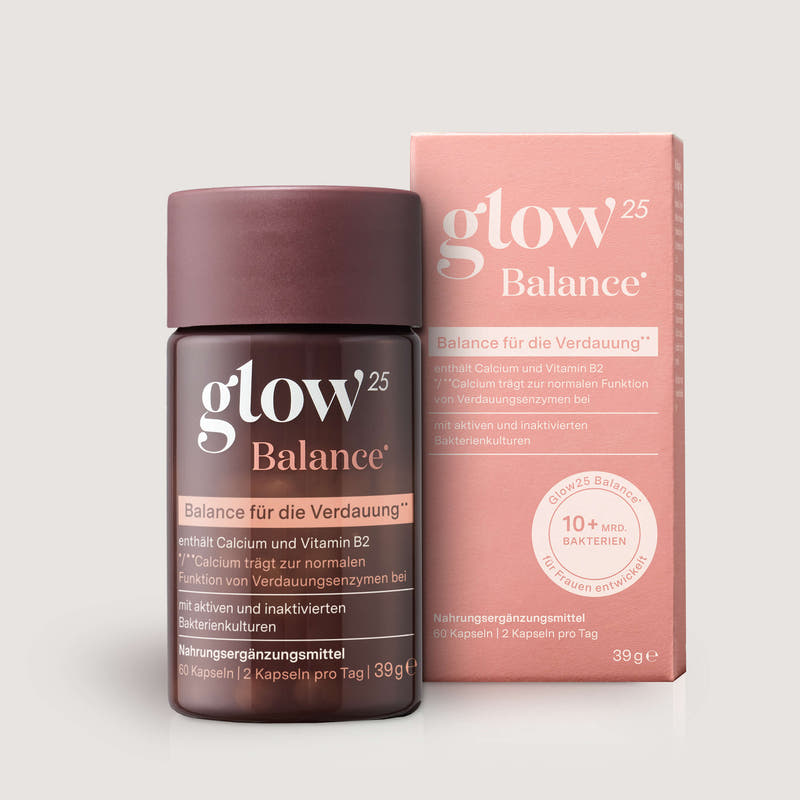
Glow25 Balance: supporting your gut flora
Once the basics — fiber, movement, chewing, hydration — are in place, targeted support for gut flora can make sense. Glow25 Balance combines a 3-in-1 tribiotic formula of inulin and gold kiwi extract (feeding the good bacteria) with active and inactivated lactic acid bacteria cultures, rounded out with vitamin B2 and calcium, which supports the normal function of digestive enzymes. Taken daily with plenty of water, it fits easily into an existing routine.
Discover Glow25 Balance →Gut flora and probiotics: what the evidence shows
Fiber and movement are the foundation — but gut flora composition matters too. A randomized, double-blind trial with 250 adults with functional constipation compared different fiber and probiotic combinations against placebo: all active groups showed noticeably improved stool consistency versus placebo.[8] Importantly, results depend on bacterial strain and dose, which is why blanket recommendations are tricky.
What customers specifically appreciate about Glow25 Balance
Real customer reviews of Glow25 Balance show a recurring pattern: several users report a noticeably smaller afternoon energy dip within just a few days of starting, and describe fitting the capsules easily around other supplements — for example morning thyroid medication — as long as some time is left in between. A few also mention that their stomach reacts if both daily capsules are taken at once instead of spread out, a useful reminder that the recommended intake and spacing matter.
Why Glow25 stands out here
Unlike many standalone probiotic products, Glow25 Balance uses a 3-in-1 formula combining active and inactivated lactic acid bacteria cultures with inulin and gold kiwi extract — in other words, both feeding the good bacteria (prebiotic) and supplying them directly (probiotic), rounded out with vitamin B2 and calcium. That lines up with what the studies above suggest: fiber and bacterial cultures often work better together than either one alone.
Common reasons people notice a difference
- Consistency over perfection: people who keep up small daily habits (movement, chewing, hydration) report steadier results than with occasional "detox" efforts.
- Gradually increasing fiber instead of switching all at once, to avoid bloating during the adjustment phase.
- Walking right after eating, not just "sometime during the day."
- Patience: most of the cited studies show effects only after several weeks of consistent use.
What the studies show: summary
- Fiber lowers laxative use and raises bifidobacteria in stool in older adults with chronic constipation.[1]
- Fermentable fibers like oligofructose and FOS increase stool frequency in people with low baseline fiber intake.[3][4]
- A short walk after eating can relieve bloating about as effectively as a common medication.[5]
- Regular activity is linked to lower constipation risk, inactivity to higher risk.[6]
- More chewing cycles per bite measurably speed up gastric emptying.[7]
- Combining fiber and probiotics improves stool consistency in functional constipation more than placebo alone.[8]
Who benefits most from these tips
- People with sluggish digestion in daily life who sit a lot and struggle to fit in movement.
- Anyone on a low-fiber diet, often from convenience foods or refined flour.
- People who eat on the go and tend to rush meals.
- Anyone from their mid-30s onward, as digestion shifts with age and hormones.
- Anyone already taking probiotics who wants to support the effect with a higher-fiber foundation.
How this fits into your routine
A realistic approach looks like this: increase fiber-rich foods gradually over two to three weeks instead of overhauling everything at once. Plan a short walk after lunch and dinner, even if it's just a lap around the block. Chew more deliberately, especially on the first bites of a meal — after that, it's easier to keep the pace. And drink throughout the day instead of catching up all at once in the evening. None of this requires a new product — that's what makes it sustainable.
Frequently Asked Questions
How can I improve my digestion quickly?
There's no instant fix, but three levers tend to work comparatively fast: a 10-15 minute walk after eating, staying hydrated throughout the day, and chewing more thoroughly. Research shows light movement after meals can noticeably reduce bloating in the short term.[5]
Which foods improve digestion the most?
Fiber-rich foods like whole grains, legumes, vegetables and unpeeled fruit are what studies most consistently link to smoother digestion: more stool bulk and shorter transit time.[1][2] Fermentable fibers like inulin also support bacterial diversity in the gut.
How long does it take for more fiber to improve digestion?
In controlled trials, improvements in stool frequency and gut flora usually appeared after several weeks of consistently higher fiber intake.[3] Some people notice more bloating during the adjustment phase before the gut adapts.
Does exercise really help with digestive issues?
Yes, though not every type of movement helps equally. Regular moderate activity is linked to lower constipation risk in cohort studies, and a short walk right after eating performed comparably to a common anti-bloating medication in a randomized trial.[5][6]
Does chewing slowly really make a difference for digestion?
A frequently cited study in the Journal of Dental Research found that more chewing cycles per bite measurably sped up gastric emptying, because food arrived in the stomach in smaller particles.[7] Thorough chewing is a simple, free lever.
Can probiotics improve digestion?
The evidence is strongest for combining fiber with probiotics: a randomized trial with 250 adults with functional constipation found this combination noticeably improved stool consistency versus placebo.[8] Individual bacterial strains work differently, so it can take some trial and patience.
Conclusion
Improving digestion is rarely about one single "miracle fix" — the evidence fairly clearly shows that fiber, movement after eating, thorough chewing, and balanced gut flora work together. Stick with these fundamentals consistently, and add targeted gut-flora support where it makes sense, and you have a good shot at a noticeably lighter, more comfortable gut feeling — without overblown promises.
Ready to give your digestion a hand?
Discover Glow25 Balance now →Learn more

Sources: [1] PMC12249261 (Nutrients, meta-analysis fiber in chronic constipation, elderly) · [2] PubMed 35816465 (meta-analysis fiber supplementation, adults) · [3] PMC5748822 (RCT oligofructose) · [4] PMC11675838 (meta-analysis FOS) · [5] PMC8035544 (RCT walking after meals vs. medication) · [6] Systematic review, physical activity and constipation · [7] PubMed 11876271, J Dent Res 2002 (Pera et al., mastication and gastric emptying) · [8] PubMed 37078654 (RCT fiber/probiotics in functional constipation)


